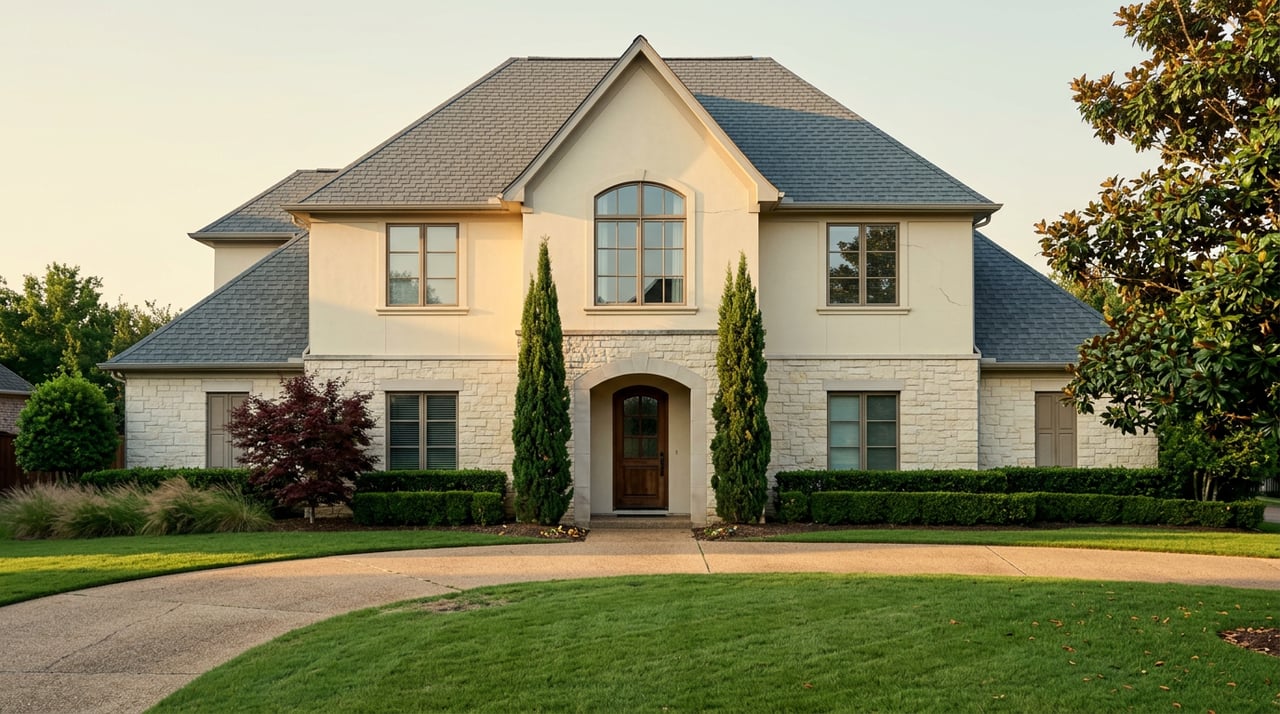
Why Every Site Gives You a Different Number for Greer's Median Home Price
September 10, 2026
September 10, 2026
Search "Greer SC median home price" this week and you will find three answers that do not agree. One portal's February 2026 data puts the median sold price at $303,000, down 8 percent from a year earlier, based on just 34 closed sales that month. Another portal, pulling from April 2026, shows $379,900. A third, using March 2026 numbers, lands at $330,000. Three sites, three months, three numbers that differ by nearly $77,000.
None of them are wrong. They are each describing a different slice of a city that behaves like two markets wearing one name.
Greer is one of the few cities in the Upstate that physically straddles a county line, with roughly 60 percent of the city sitting in Greenville County and the remaining 40 percent in Spartanburg County. That line does more than decide who mows the median on your street. It determines which school district your address feeds into, which tax office sends your bill, and which of two genuinely different housing markets your comp set actually belongs to. A buyer comparing a listing to "the Greer median" without knowing which side of that line the house sits on is comparing it to a number that may have nothing to do with the house in front of them.
The clearest way to see the split is to look at what a buyer's money actually buys in different corners of the city, not what a single median implies.
| Submarket | What it is | Typical entry price | What's driving it |
|---|---|---|---|
| Sugar Creek and River Oaks | Established, tree-lined subdivisions built out over decades on the Greenville County side, zoned to Riverside High and Riverside Middle | Low $300s to high $400s | Mature landscaping, long resale history, direct comps between similar floor plans |
| O'Neal Village and nearby new-construction pockets | Active builder communities closer to the Spartanburg line | Low-to-mid $300s | Competing volume builders, incentives, newer inventory keeping supply loose |
| Downtown Greer, the Trade Street corridor | Renovated bungalows and infill lots inside Greer Station, walkable to dining and shops | Price per square foot often north of $220, even on smaller footprints | Scarce historic stock, walkability, lifestyle demand that isn't tied to square footage |
A buyer using a citywide median to judge whether a Sugar Creek listing or a downtown bungalow is priced fairly is using the wrong yardstick in both directions. The subdivision buyer is shopping in a market with direct, apples-to-apples comps three doors down. The downtown buyer is paying for scarcity and location, and a standard 1990s ranch nowhere near Trade Street will not command the same price per square foot no matter what the citywide median suggests.
The county split is not a trivia point. It changes three things a buyer needs to confirm before writing an offer, and none of them are reliably visible from a listing photo or a zip code alone.
First, the school district. Homes on the Greenville County side feed into Greenville County Schools, including Riverside High and Riverside Middle on Hammett Bridge Road. Homes on the Spartanburg side of the line feed into Spartanburg School District 5. Which side a specific parcel falls on is not always obvious from the street address, since Greer's postal zip codes do not cleanly separate the two counties the way a buyer might assume.
Second, the tax collector. A Greenville County parcel is billed by the Greenville County Tax Collector. A Spartanburg County parcel is billed by the Spartanburg Treasurer. Effective property tax rates on the two sides of the line have historically differed by roughly 0.2 percentage points, and school district levies, which make up a large share of any South Carolina tax bill, are calculated separately by each county. The only reliable way to confirm which jurisdiction a specific home sits in is to check the county GIS parcel viewer directly rather than assume from the mailing address.
Third, the city's own math. Greer's current fiscal year budget, a $91.5 million spending plan adopted this summer, holds the property tax millage at 111.0 mills with no increase to the rate itself. But the budget documents also show the revenue generated per mill climbed about 9.9 percent year over year to roughly $334,605, which tells you rising assessed values, not a rate hike, are what's actually pushing tax bills higher across the city this year. A buyer budgeting off last year's tax bill for a comparable home is likely budgeting too low.
Once you see Greer as two submarkets instead of one, the conflicting medians stop looking like a data error and start looking like sampling noise. February's report captured only 34 closed sales, a small enough sample that a handful of downtown bungalows or high-end Sugar Creek closings can swing the median hard in either direction. April's larger sample of 724 sales pulled in more new-construction volume from builder communities, which tends to push the blended number up given how many units are moving through pockets like O'Neal Village. A third portal's mid-quarter snapshot landed somewhere in between, closer to the loose consensus range of $330,000 to $365,000 that several local sources converge on for 2026.
None of this means the data is broken. It means a single median for a city built from two different housing stocks, two different school zonings, and two different tax jurisdictions was never going to hold steady month to month. The number moves because the mix of what sold that month moves.
Trade Street itself is changing fast enough to complicate the picture further. Trade Street Social, a golf simulator and dining venue from Innovative Hospitality and Development, the same group behind The Mill at Fountain Inn, opened on Trade Street in June 2026, filling what its general manager described as an effort to give the community "an inviting and safe space to visit with family and friends." Just a few months earlier, in December 2025, Greer Diner opened in the former Cannon's Drive-In location, a spot that had served the community since 1971 before its longtime owners closed it.
Every new opening on Trade Street adds to the case that walkability and downtown proximity now carry their own pricing logic, separate from whatever the subdivision comps are doing a mile away. A buyer weighing a downtown bungalow against a newer build in O'Neal Village is not really comparing two houses. They're comparing two different reasons people pay for a home in Greer.
If you are comparing Greer to other Upstate suburbs, or comparing two Greer listings to each other, the median on any single portal is a starting point, not a verdict. Before you anchor a budget or an offer to that number, confirm which county the specific parcel sits in using the county GIS parcel viewer, confirm which school district the home is zoned for directly with the district rather than the zip code, and pull sold comps from the same submarket, whether that's an established subdivision, a new-construction cluster, or the downtown corridor, rather than the citywide blend.
Greer's steady draw for buyers, from its proximity to the BMW manufacturing plant to GSP International Airport sitting inside city limits, is not going away. But treating "the Greer median" as one number will cost a buyer real money in either direction, either by overpaying for a downtown premium they didn't need or underbidding on a subdivision comp they misjudged.
If you are trying to figure out which side of Greer actually fits your budget and your must-haves, Jason Boozer has spent three decades working these specific streets and can walk you through which submarket you're really shopping in before you write an offer. Let's connect.
Stay up to date on the latest real estate trends.

Rooted in Simpsonville, I deliver expert guidance and a personalized approach to help you buy or sell with confidence—and achieve exceptional results.
Jason Boozer
148 Milestone Way Ste D Greenville, SC 29615