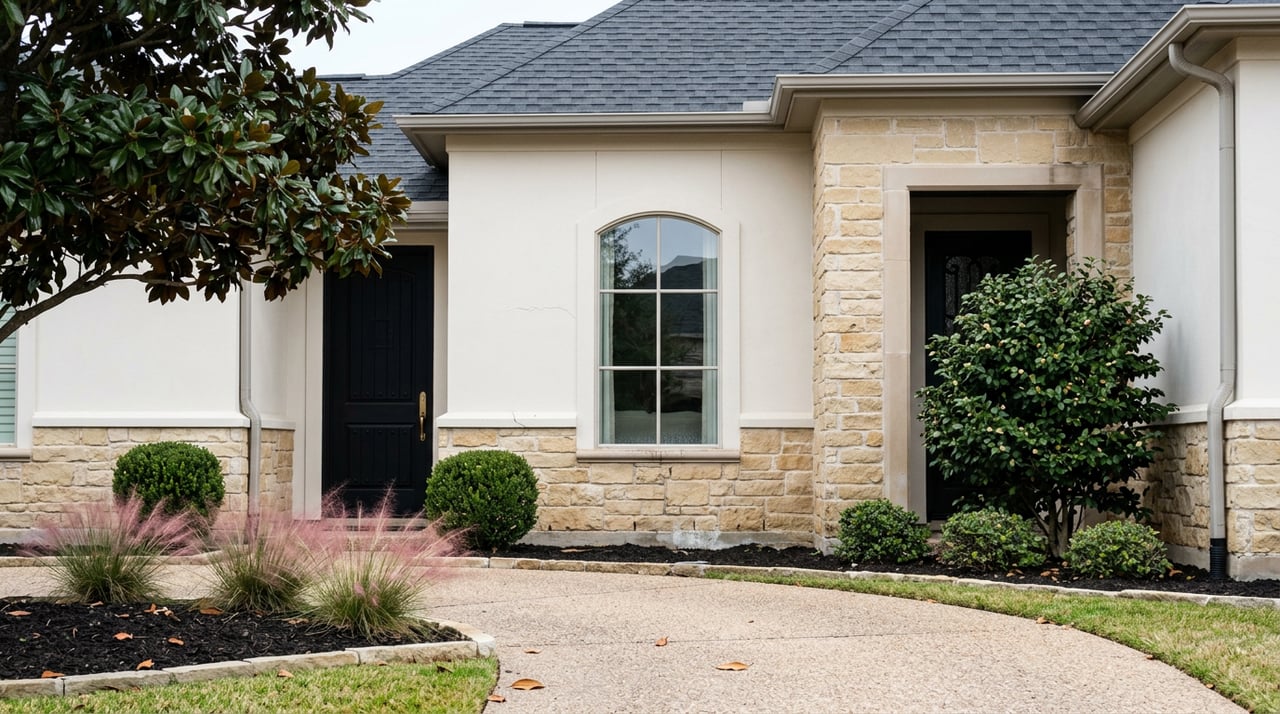
Why Fountain Inn's County Line Shows Up at Your Closing Table, Not Just Your Tax Bill
September 3, 2026
September 3, 2026
A house on Beechcroft Place and a house in Reedy Creek can both call themselves Fountain Inn, sit inside the same school attendance boundary conversation, and still close on completely different paperwork. One is in Greenville County. The other, according to its own builder marketing, sits in Laurens County. Neither listing photo tells you that. Neither does the address.
Most people treat Fountain Inn's split location as a piece of trivia, the kind of fact you mention once and move past. It isn't trivia. It's the thing that decides which courthouse your deed gets recorded in, which county's tax schedule prorates your closing costs, and which school district shows up on your child's enrollment paperwork. None of that gets fixed by a good inspection or a sharp negotiator. It gets fixed by knowing which side of the line your parcel sits on before you write an offer, not after you're already under contract.
Fountain Inn's northern and central sections fall inside Greenville County. The southern edge of the city extends into Laurens County. A buyer looking at new construction off Abercrombie Road is dealing with one set of courthouse records. A buyer looking at a rural property off Cooper Bridge Road is dealing with another. The city limit doesn't track the county line, so two homes a few streets apart, both comfortably inside Fountain Inn, can answer to two entirely separate county governments.
That split matters most in three places: the title search, the tax bill, and the school assignment. Each one behaves differently depending on which side of the line a given parcel happens to sit on, and each one is the kind of thing that surfaces during a transaction, not before it.
A title search is only as good as the records it pulls from. If your closing attorney searches the Greenville County Register of Deeds for a property that actually sits in Laurens County, a mechanic's lien or a tax judgment filed at the Laurens County Clerk of Court simply won't show up. The search comes back clean. The lien doesn't disappear. It just stays invisible until it resurfaces, usually at the worst possible time.
When a parcel physically straddles the line, the fix isn't optional. Deed and mortgage documents have to be recorded in both counties, formatted to each county's own recording standards, because a single filing in one county's Register of Deeds doesn't establish ownership on the portion that falls in the other. This isn't a matter of thoroughness. It's a matter of pulling from the correct courthouse in the first place.
Greenville and Laurens counties run different millage rates, different assessment cycles, and different billing schedules. Greenville County's own auditor's office notes that millage rates vary across 136 separate tax districts within Greenville County alone, before Laurens County's entirely separate schedule ever enters the picture. Laurens County publishes its own rates on its own timeline, and the two schedules were never built to line up with each other.
That's the part a citywide tax estimate can't capture. Search for a typical Fountain Inn property tax figure and you'll likely land on a tool that reports something like a 0.82% effective rate tied specifically to the Greenville County side of the city. That number was never describing the Laurens County side. If the home you're looking at falls south of the line, the estimate you found with a quick search was never built to include it.
This isn't a hypothetical risk. In September 2024, the city of Fountain Inn announced that a mathematical error at the Laurens County Auditor's office had miscalculated the local option sales tax credit applied to 2023 tax bills for the city's Laurens County properties. The mistake meant the county failed to remit more than $400,000 to Fountain Inn over a single fiscal year. To correct it, Laurens County property owners saw the increase show up directly on their 2024 tax notice, and the city noted that owners who escrow their taxes through a mortgage servicer might see a further adjustment in 2025 payments, with instructions to contact their servicer for specifics. A closing attorney who properly prorates taxes at the settlement table is protecting a buyer and seller from exactly this kind of cross-county miscalculation. That protection only works if the attorney knows which county's schedule actually applies.
Ask which schools serve a Fountain Inn address and the honest answer is: it depends which county you're standing in. The Greenville County side is zoned to Greenville County Schools, including Fountain Inn Elementary and Fountain Inn High School on Quillen Avenue, a school the district built specifically to serve growth in this part of the county. The Laurens County side answers to Laurens County School District 55, with schools like E.B. Morse Elementary, Ford Elementary, Laurens Middle, and Laurens District 55 High. Public school locator data puts several of these Laurens County schools essentially the same distance from central Fountain Inn as the Greenville County schools carrying the Fountain Inn name. Proximity doesn't predict district. The county line does.
For a family comparing two Fountain Inn listings side by side, that's not a footnote. It's a different district, a different calendar, and a different set of schools entirely, decided by which side of an invisible line the house happens to sit on.
Builders selling in Fountain Inn mostly market the city name and skip the county. Communities like Briargate, Stoneledge Cottages, Blue Ridge Trail, and the Hamptons all advertise simply as "Fountain Inn, SC," with no mention of which county a buyer is actually purchasing into. Reedy Creek does the opposite. Its own listings describe it as sitting in Laurens County, and the marketing leans into it as a selling point rather than hiding it.
That contrast is worth sitting with. Some of the newest inventory in Fountain Inn is being sold without the one detail that determines your tax schedule and your school assignment, while at least one community treats that same detail as a feature. A buyer comparing new construction across Fountain Inn should ask the builder directly which county a specific lot sits in, in writing, rather than assuming the marketing name settles it.
How do I find out which county a specific Fountain Inn address is in before I make an offer? Greenville County maintains public GIS parcel maps that show parcel boundaries and jurisdiction. For addresses near the county line, cross-checking a parcel against that map, or asking your agent or closing attorney to confirm it directly with the county, is the surest way to know before you're under contract.
Does the county line affect my mortgage rate or my lender's requirements? No. Loan terms and lender requirements don't change based on which county a Fountain Inn property sits in. The friction shows up in title work, tax proration, and school zoning, not in financing.
Will buying on one side of the line affect resale value later? That's not something to predict with a general rule. What's knowable now is that the two sides of the line carry different tax schedules and different school assignments, and both are worth understanding on their own terms rather than treating Fountain Inn as a single, uniform market.
The county line running through Fountain Inn isn't a problem to solve once you're at the closing table. It's a question to ask before you ever write an offer. If you're comparing homes across this part of the Upstate and want someone who already knows which side of that line a specific address falls on, Jason Boozer is happy to walk through it with you. Let's Connect.
Stay up to date on the latest real estate trends.




Rooted in Simpsonville, I deliver expert guidance and a personalized approach to help you buy or sell with confidence—and achieve exceptional results.
Jason Boozer
148 Milestone Way Ste D Greenville, SC 29615